Sunday, March 17, 2019

Emerald Isle Ancestors

(https://upload.wikimedia.org/wikipedia/commons/8/82/Kilbennan_St._Benin%27s_Church_Window_St._Patrick_Detail_2010_09_16.jpg)

This is a day of long tradition, Irish tradition;  a day that that people enjoy celebrating whether they have Irish roots or not. 'Lá Fhéile Pádraig' is held on March 17th which is the traditional date of the death of St.Patrick, a patron saint of Ireland who apparently was taken to Ireland as a slave, escaped back to his family, but later returned as a missionary to convert the Irish to Christianity and free the country of snakes. It is an unusual story and it is not known whether the snakes were actual, or perhaps a religious metaphor for 'pagans'. St. Patrick is one of the three patron saints of Ireland and is buried in Down Cathedral in Downpatrick. 


(https://commons.wikimedia.org/wiki/File:Saint_Patrick%27s_grave_Downpatrick.jpg)


This celebration was documented to have been observed in New France by Irish soldiers serving in the British army in 1759. Montreal has had a St. Patrick's day parade since 1824, and Newfoundland will celebrate the occasion today, Sunday, and have a local holiday tomorrow. I am not sure whether there is the same component of religious remembrance now or if it is simply a celebration of all things green.


My sweetie Lynn O'Beaudoin 


For me, it is a reminder of an immigrant past. I have spent many hours climbing the branches of my family tree. My father's direct blood line leads back to my 3 times great grandfather who was born in Yorkshire, England, while my mother's maternal line draws from a Huguenot past. Dad always thought that there were Irish roots and that they came from his grandfather Thornton (my maiden name). I discovered that that said grandfather, Francis Leonard Thornton, had married Margaret Nixon, and her father, Hugh, was born in Ireland. So there is my Irish immigrant ancestor. 


 (Great grandfather Francis is on the right hand side behind his wife Maggie Nixon in this scan of a tiny tintype photograph found in the Nixon Bible)

In the tiny graveyard where Hugh and much of his family are buried, there are  stones for James and Ann Nixon, who, given the dates on the stones, the style of the stones and the proximity of the all these stones, leads me to believe that James and Ann would be my 3 times great grandparents. I have not seen any documents at this time to confirm this but I think that it is a safe assumption. 
(It can be noted that Ann was made of stern stuff because according to this gravestone inscription,she lived to the venerable age of 104 years!)


The only link to a place in Ireland that I have seen, is the gravestone of Hugh's older brother, George, which refers to him as a 'Native of Tyrone Co. Ireland'. This is only specific enough to place my roots in one of the six counties of Northern Ireland. 


The next thing that I know for sure, is that Hugh Nixon married Matilda King in 1830. This particular document was not especially helpful for a granddaughter looking for information almost 200 years later, and does not give parents names or places of birth like most later documents of this sort would provide. So while  it confirms a marriage and a date, it only tells me that sometime between when Hugh was born in 1802ish, and 1830, he arrived in Canada. 


(May 5th 1830   'Celebrated marriage by license, between High Nixonof the Township of Esquesing in the Gore District, Upper Canada, bachelor and Matilda King of Etobicoke, Home District, spinster.')


Most overseas travelers arrived in Quebec City and the transcripts of ship's lists this early mostly note a number of passengers and a point of origin. The St. Lawrence Seaway was many years in the future so coming up the river with its many rapids would have been as perilous as crossing the ocean. They did however end up safely in Halton County, Ontario, and established families and homes. This was prior to the potato famine and the later religious troubles, so it is unknown what prompted a journey that left everyone and everything that was loved and familiar, to come to an unknown place and future. Remarkable really, the courage it took to make a journey of this magnitude.
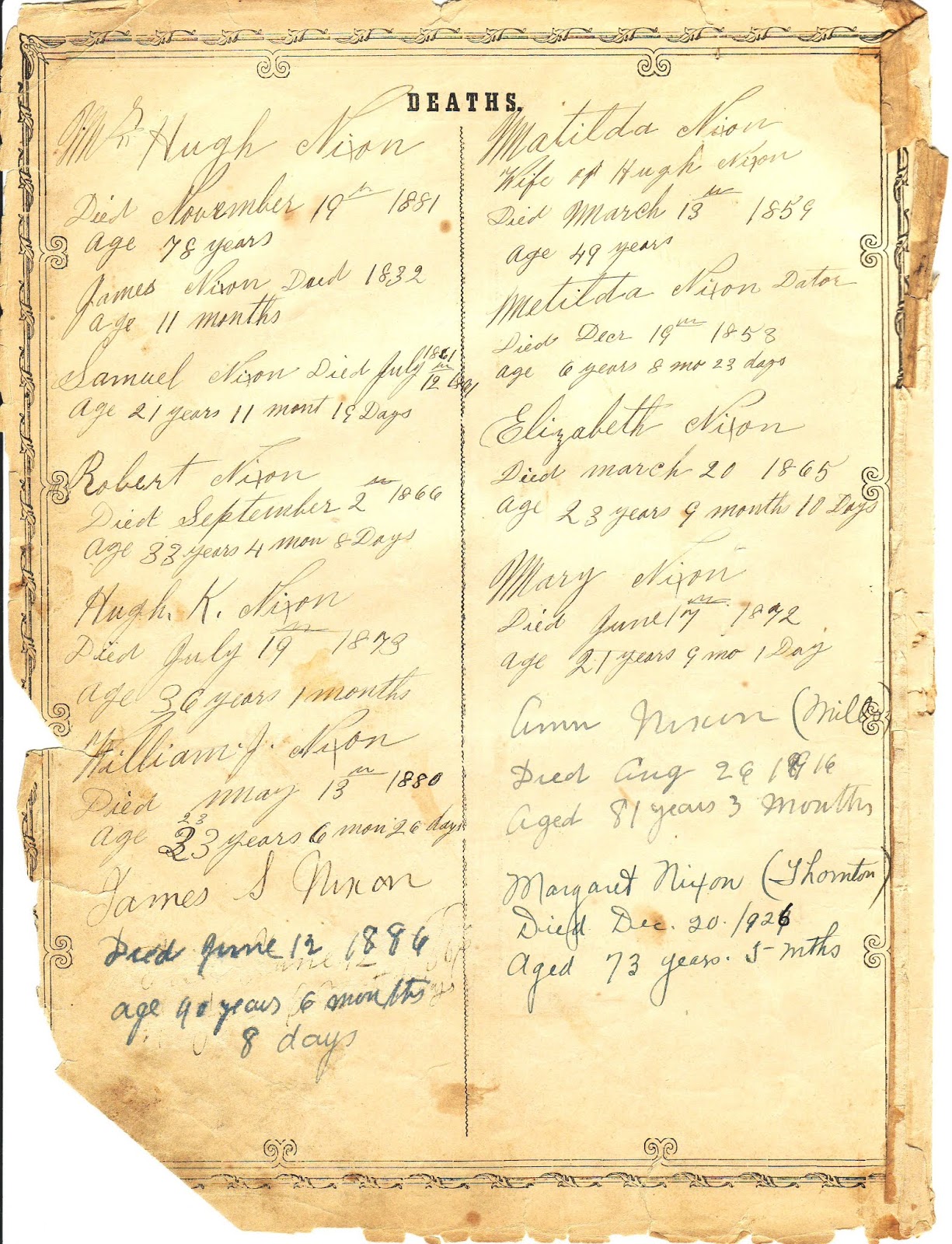


Hugh and Matilda's family deaths as recorded in the Nixon Bible. 


My great grandparents Francis Leonard Thornton and Maggie Nixon Thornton later in life at their home in Toronto.

So on this unique day, I remember Hugh Nixon, about whom I know so little but who is my genetic and ancestral connection to a land across the ocean. It is important to remember that most people who live on this continent do so because of immigrant ancestors, and that they brought with them beliefs and traditions which we now celebrate. Happy St. Patrick's Day!


Wednesday, March 13, 2019

A change in the air...


There is a change in the air, and despite the remaining presence of snow and cold temperatures, there is definitely the scent of spring. I am hoping that the change of the external season will also bring a change in my internal season. Winter has been a long, grey time and I don't think I have been in hibernation exactly, but perhaps more like in a state of torpor. Hibernation and torpor are methods animals use to survive winter, with hibernation being like a deep, deep sleep and torpor being periods of sleep broken by periods of activity. So while outwardly continuing the activities of life, inwardly, I have been quiet, removed, needing of a great deal of solitude. This is the first time that I have written for a while but perhaps there are seasons for words also. 


I felt that the time of snow was ending so I had better enjoy its presence before it had gone completely. There are many wonderful things about these last snows when the season is on the cusp of a new fresh one. A pristine cover of snow in the bright sun is a thing of great beauty, but it also allows a glimpse into life in the forest become invisible once it is gone. Like...nature's artwork in the snow..


showcasing small things of beauty..


like a vine tendril..


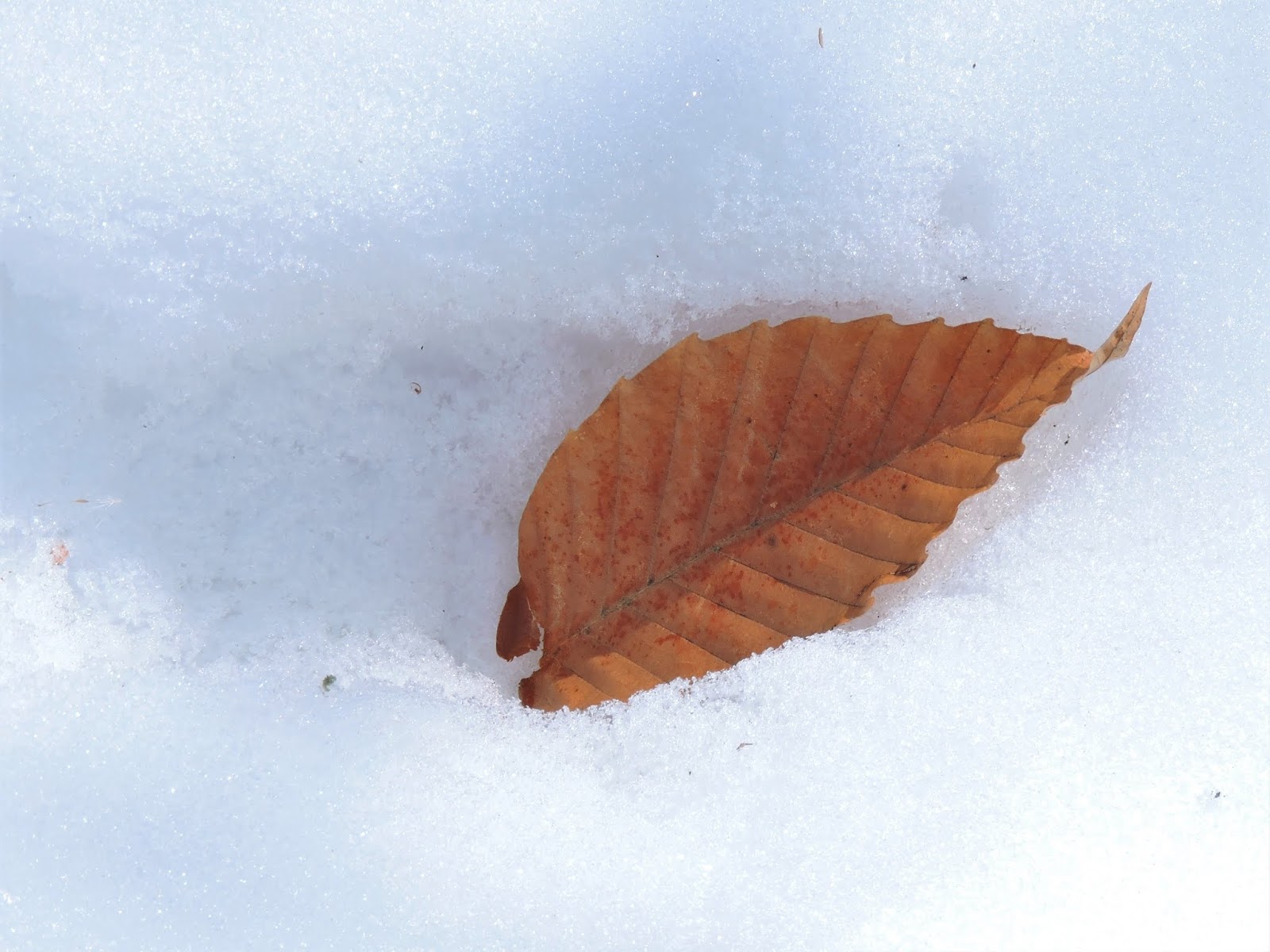
or an beech leaf..


or a feather.

Or showing evidence of who has been present in the forest like..


a deer mouse with tiny feet and a dragging tail,


a hungry rabbit..


a meadow vole, whose subnivean (under the snow) tunnels become apparent as the layers of snow begin to melt,


or this intersection of prints which show that a deer mouse (diagonal), a deer (vertical), and a squirrel (horizontal tracks) have all been in the same area recently.


Ice is a winter companion also, dangerous underfoot but spectacularly beautiful in all its forms....


gravity-defying icicles.


ice baubles dangling over the creek,


patterns in frozen puddles and


 at the river's edge.


Not only is there a whiff of spring in the air, but the silence of winter in the forest is beginning to give way to the sounds of approaching springtime. The birds that remain here year-round are quieter in the winter. They call to each other to communicate where they are, or if there is food to be shared, or if there is danger close by. Now their repertoire expands to include mating calls and territorial warnings.


The male cardinal is heading up from the shrubbery to the treetops to sing for a mate and to establish his 'patch'. The chickadee's songbook will now include a distinctive two-note song as well as the well-known 'chick-a-dee-dee-dee', as he sings seeking companionship. The sparrows are starting to squabble and investigate the possibilities for nesting.


One of my favorite things is to watch the squirrels waking up and joining the mating game. Many are nesting right now, probably in a hole in a tree, but there is plenty of noisy chasing and chattering going on.


The grey squirrels and the black ones,(who are also grey even though they are black and often have red belly fur), are busy building a drey to nest in. (Not dray, as in cart, or dre as in Dr.) There is a hollow centre to these nests that is lined, warm and soft for babies. They seem to defy gravity and the effects of weather, so they must be well built. With the leaves still being absent, it is possible to see the squirrels doing parkour in the trees, as they pursue the activities for which the nest is prepared, ahem.  


The remaining snow highlights the changing colours.


The Red-osier dogwood's red bark is so bright and cheerful, 


while the youngest branches of the willows glow a soft and warm gold.


The moss seems more verdant as it is still the only thing around that is green. 


Even the sky seems a brighter blue as we welcome back the presence of the sun. Life will go on as before, but it just seems more hopeful and easier to bear when the sun is shining, and when we know that Spring is in the air.


Wednesday, January 9, 2019

Closure....


I bumped into my age the other day. It used to be called 'the generation gap', those differences that exist between parents and children because they are growing up in a different time. I told my son that I had watched the digital version of my brother's funeral service*, and he looked alarmed and asked 'why?'. I looked puzzled and thought 'why would I not?'. 'Oh', he said. 'Did you need closure?' (*refer to blog of 3 Nov 2018)
Sons, especially grown ones, do not like their mother to be upset, which is endearing and thoughtful protection but not always realistic. Painful things happen, and often, without notice and invitation. He did however understand that there might be a purpose for my action, this being 'closure'.
I have thought about this a lot since that conversation. I do not remember that word being used in this context for most of my lifetime. According to the dictionary the original word 'closure' apparently came from 'enclosure', the means of keeping something enclosed. Computer and mathematical fields use the word with this same implication, like a number set or an operation that is closed. For most of my life 'closure' was when something closed, like a business closure, or 'something that closes', like a skirt with a zipper closure. 

Now, as with many other words, the meaning has morphed into something different. The Urban Dictionary defines 'closure' solely in terms of relationships, as in being able to 'move on' after the termination of an unsuccessful relationship. It is more broadly used as the sense of bringing something to an ending, or something that facilitates that process, as in a victim finding closure to a painful experience and perhaps a trial, aiding that process. 

The generation that raised me was not one to display, or encourage a display or discussion of feelings; there was more a 'Keep Calm and Carry On' attitude to emotion. While I do not think this is necessarily a healthy view, it seems as though the generations coming along feel that happiness is somehow a right, therefore one must find 'closure' on unpleasant things in order to return to the desired happy place. 
So what does this word even mean? Are we to forget the painful things? What place are to put them? Do we not continue to mourn the loved ones who are no longer here with us? 
Well, two months have now passed since I began this blog. It is like a tap turned off in me and I went into an internal hibernation, a kind of silence. During this time I read that when the Druids celebrated the autumn equinox, they acknowledged that it was not just a time of harvest, but, recognizing the ebb and flow of the seasons, saw it as a time for regaining internal balance and so spent time in preparing themselves for the coming dark time. 
Because they followed the sun and the seasonal changes, they knew that they would be entering a time when the hours of light would grow increasingly shorter and so the time of sunshine and activity would now change to a time of increasing darkness and rest. This was a normal, natural, and accepted cycle of the seasons. 
The work of the garden was finishing, the harvest was secured and the garden prepared to withstand the coming winter. The work of the plants and trees moved from producing above ground to sustaining deep in the ground in their root systems. The leaves dropped and became nourishing compost for the soil. Just so, the Druids recognized that similar work for physical and spiritual balance must be done. The 'composting' took the form of discarding those things which are not used or no longer serve a useful purpose. 
Time for reflection and rest is no longer built into our society; we are to work and strive all the time, ignoring the fact that the body and mind, like the earth, need to rest and replenish, and in an equal amount of time in order to be most productive.
By the winter solstice, the garden was composted and replenishing, and the time of rest with its longest periods of darkness was ending. Sleep was repairing the body and quieter, more creative pursuits were restoring balance to the mind and spirit. 
So where does this leave us, in our world, at this time? I watch my children working all hours of the day and night, shifts that upset our bodies natural rhythms and allow insufficient time for rest, never mind creativity or time to feed important relationships. And the weather has been so variable and unpredictable; it has also been unrelentingly grey and gloomy for the past months. Ironically, I read the other day of a word, coined by an Australian philosopher, to describe the distress people feel about the very real changes in our environment made by global warming; it is 'Solastalgia'.  
Obviously there are many things that we have no control over, which may be why they cause us such anxiety. I realized though, that not only did I not prepare myself for the 'dark time' of winter, or 'dark times' of life, I did not accept them as part of the calendar year, or the calendar of my life. The Druids accepted, prepared and celebrated each part of the year, including the dark time, which they considered to be a full half of it. 
I realized that 'composting' as a process is needful and helpful for emotional balance and well-being. If you do not identify those things, emotional or physical, which are not helpful to you, those things that clutter and cause upset,  and attempt to discard them, your body and mind cannot find rest.
Rest is vital for the body and the spirit and must be given priority even against the societal norm of busyness and productivity and I realized that if I did not have sufficient rest I soon lost perspective on every aspect of my life.
So...I finally realized that over these months I had unwittingly been following some these ancient practices. I moved my inner life to a place of quiet where I could think. I read a lot and tried to be creative in those quiet spaces. I tried to identify those thoughts, feelings and even physical things that caused me disquiet in an effort to 'compost' them and find more positive thoughts and pursuits. I walked often, immersing in the beauty of the forest and the joy of the birds. I allowed myself to nap when weary. I am of an age when I have that luxury and am grateful for it for I remember the freneticism of younger years.
And I came to decide after months of mulling, that 'closure' was more preferably defined as 'acceptance'. I deplore its common usage which implies that the person finding closure has been clearly wronged or misused and the closure involves an action of revenge or justified abuse. I do not think it necessarily means that a resolution has been reached either. There is no resolution to death, loss and dark times. I also do not think that 'enclosure' describes it completely, as that to me implies drawing a circle around an event and putting it away. 
In order to find a 'closure' to my brother's death, I needed to accept all the circumstances of his passing. I needed to take part in the funeral that commemorated his life. I needed to examine all the feelings of pain as well as guilt that I had over things not said or done. Then I just needed to 'be' for a while. Then, after a while, I found a feeling of closure. I found it more slowly than my sister-in-law, as her experience had the intensity of daily inexorable loss and grief.  But, what I found  miraculously, was that the process had given me back my brother. I was free in a way to have Al back in a whole form; my big brother, his grin and his voice. It is wonderful and unexpected and welcome. I will always feel his loss, yet I feel a renewed presence with me.
Have I now become more accepting of the dark times? Am I more prepared? Probably not. Sometimes the pall of winter grey is overwhelming. But as the seasons inexorably change, the dark time is growing shorter and the blessing of spring does thankfully approach.


Opposites Attract/Les contraires s'attirent

On October 14th my husband and I will have been married for 47 years.  My grandparents were married 62 yrs, my parent's 61, and my oldes...