Showing posts with label change. Show all posts

Thursday, March 18, 2021

On turning 100, English version

 Last month our tante Julie turned 100 years old. This August my mother-in-law Evelyn will turn 98. So amazing; almost 200 years of experience between these two special women. I realize that we have all lived to see this century turn, but most of us have not lived the balance of our life in the previous one. Both tante Julie and Evelyn were born in rural Quebec in the 1920's; tante Julie in Montmagny, on the St Lawrence, in 1921, and Evelyn in 1923 in the small Eastern Townships community of North Hatley.

(Montmagny  pres du haut, North Hatley petit point rouge pres du bas)
(Montmagny at the top, North Hatley red dot to the right of Magog)

 Tante Julie was born into a French family and her grandfather, Nicholas, born almost 100 years before her in 1822, was in the 1860 census shown as being a 'voyageur'. We generally associate this with canoes and the fur trade, but at this time it may have also referred to someone who made his living on the river. Her parents, Proculus and Blanche, were married in 1916 and tante Julie was their first daughter.


Evelyn was born into a large English speaking family, one of many in Quebec whose roots were in the US, having originally crossed the Atlantic from Europe at some distant time. Life was hard, work difficult to find and money scarce, but Mom remembers a happy home and good memories. One particular story lingers in my mind. Grandma Bryant had one good dress which she had washed and hung on the line to dry. Apparently one of the cows thought this might be tasty and began to nibble on the dress. Grandma, upon spying this heinous sight, took off after the cow with Grandpa's axe in hand. As Grandma Bryant stood about '4 foot and not much', this brings a memorable picture to my imagination and clearly an indelible one to my husband's young mind.

(Grandma Bryant whom Evelyn called 'her little Mama')

What stands out in my mind about this time in history is how dangerous it was. Both tante Julie and Evelyn had siblings born during the time of the 'Spanish flu'. Life expectancy for adults was about 50 years, and in Quebec, one in four children died by the age of one.  In statistics gathered from 1925-1926, there were over four maternal deaths a day. Water was not not pure, sanitation uncertain, milk not pasteurized and diseases like diptheria, typhoid, cholera and TB were still causing epidemics and accounting for yearly deaths. In 1927 there was a typhoid fever outbreak in Montreal which had 5000 cases, 10% of those died. 


For tante Julie these were dangers lived out in her family experience. Of the six children born to her parents, only two were still living in 1945, one having died in infancy, and one aged 7. Further, Blanche, tante Julie's mother, died within two weeks of giving birth to her last child. At this time births primarily took place in the home and if there was a doctor, he was called out and there was a bill to pay for the services. If paying this bill was already a hardship, it was not uncommon for a woman to then suffer without the further services of a doctor, even if she did not seem to be recovering from the birth. Whatever the reason for Blanche's untimely and early death, it left Proculus without a wife and tante Julie and her four siblings without a mother. 


If being born was perilous, surviving childhood was equally fraught. In 1916 there was an epidemic of infantile paralysis. In 1930 the case numbers yearly were still growing, and in 1937 when there was another severe epidemic, there was only one iron lung in all of Canada. A vaccine did not become available until 1952 but polio peaked in 1953 in Canada with 9,000 cases and 500 deaths. When Evelyn and tante Julie were born, scientists will still working on the first vaccines for diphtheria, pertussis, TB and tetanus. (As an aside, it is interesting to note that in 1853, in Britain, a vaccine became available for smallpox, a virulent killer. The ruling of the government to make vaccination mandatory resulted  in riots and the formation of the Anti-Vaccination League!)


Scarlet fever was fatal in 1871 and still present in 1921.


For the parents of Evelyn and tante Julie, World War I was still in the recent past. In the near future was the Stock Market Crash of the fall of 1929


to be followed by the Great Depression. By the time tante Julie and Evelyn were 20, the world was once more at war and this time, uncles, brothers and school mates would go perhaps never to return. Rolland, tante Julie's brother, attested in March 1942. 


Rolland did not return home.

L'Action catholique 20 dec 1945

Being from an English community meant that, for Evelyn, more of the 'boys' that were school chums, as well as male family members, went overseas. While a generation of men fought, the women at home had to work the farms and factories to support their families and the war effort. Evelyn went to work at a large factory in Sherbrooke using a lathe to make parts for Bren guns and tanks.


When the war ended, Evelyn's brother returned home, but many of her friends did not. The men and women that returned from war were changed but expected to return to 'normal' life. Evelyn and tante Julie married brothers, one of whom had been to war. This is how they met; two women of similar age but who came from different backgrounds, religions and language.

(Baptist Church, North Hatley   St Thomas, Montmagny)

Life's events however, conspired to separate them for over 50 years but there is much irony in the fact that they both had difficult marriages and ended up raising their families on their own. 

It seems to me that 20th century was a time of extraordinary change. The year that tante Julie was born, William Lyon MacKenzie King became Prime Minister; there have been 18 elections since then.


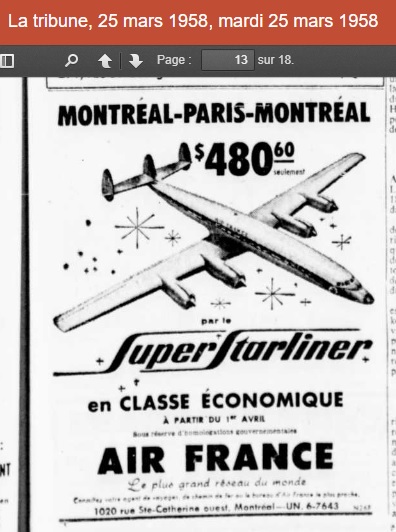
We went from Wright's gliders to supersonic jets; looking at the moon to walking on it, and then scientists living in space. Model T's of the 20's, owned by the few, became cars in virtually every family driveway and some those powered by battery instead of fuel. Computers! Starting out the size of entire rooms morphed into the nanotechnology of the microscopic. (Personally I still don't get the abacus and seniors who embrace the ofttimes terrifying and ever-evolving world of the computer are to be lauded. Thank goodness my three year grandson can explain things for me.)


The heavy rule-laden Victorian age became the rebellion of the 20's when women dared to cut their hair and show the silhouette of their bodies. Prohibition was repealed in most of Canada in the 20's followed by an increased use and abuse of prohibited substances. the dangers of smoking was documented in the 1950's.


          La Presse 1927                 Apr 1955 Sherbrooke  Daily Record

  The 20's still were fraught with the dangers of serious disease but vaccines were discovered and made mandatory virtually eradicating childhood disease. It became possible to transplant organs successfully and artificial limbs were developed. DNA and sequencing technologies were discovered.


 There were so many important, life-changing, even miraculous discoveries in such a relatively short period of time, and all while tante Julie and Evelyn were surviving childhood, marrying, raising their own children, and enduring the challenges of life. Things that gradually became incorporated into the way we live almost without notice. 

(26 May 1942 Sherbrooke Daily Record)

And now to live into the next century where everything moves faster, gets smaller and more efficient, and moves in the realm of theoretical science and the engineering of the impossible.

It seems grossly unfair that having survived the Spanish Flu of 1918 and many subsequent years, the Asian Flu of 1957 and the Hong Kong Flu of 1968, that tante Julie should be in quarantine for Covid 19 on her 100th birthday because her accommodation changed. On the other hand, tante Julie has survived 100 years of life's adversities. She and Evelyn have endured the loss of family members; parents, siblings and children. They have lived through periods of universal and personal hardship and learned to live with less. They have experienced illness and learned to live with the restraints of aging bodies. 


If was such a moving experience to see them re-united after so many years. The barrier of language is still there but the bond of shared experience was greater. The bringing together of their families was joyous. The barrier now is a pandemic and time which separates us all. It is painful and seems endless, yet we hope for a joyous reunion.

tante Julie(left) and Evelyn (right)

As I ponder the amazing discoveries of the 20th century, it becomes apparent that while medicine and science evolved exponentially, society as a whole has not. We still have in place huge inequities, racism and prejudices of all types. We may be enlightened in many areas, but a darkness continues to prevail in others. There are pockets of hope though, when we see that two women of different race, religion and language can still find common memory and love for one another even after 50 years. 


Sunday, January 24, 2021

View from the window...Oh, who are the people in my neighborhood


For parents of a certain age, whose children are a little older than is comfortable admitting to, that is a familiar song from the childrens' television show Sesame Street. That was when, next to Mr. Roger's Neighborhood, Sesame Street was the show that kids grew up on. It was familiar, part of our daily routine..kind of like our neighbours.


We have lived in this neighborhood long enough to pay off a full term mortgage, see our children mature, marry and provide us with grandchildren. When we moved here we were the new kids on the block; a harried, working, broke young couple raising young boys.  

We are now among the few 'mature' couples on the street. We have lost many of our older friends, and those remaining are eyeing accommodation that does not require mowing or shoveling or chimney repairs. 

In this weirdest of times, while we 'stay at home', my view of our neighborhood is narrow, limited to my window primarily, as we are not outside interacting in normal ways.


Lest you think that I only think about birds and squirrels, although, 'slightly reclusive' may apply to my personality, I do see and am interested in my neighbours. You will have to settle primarily for pretty winter photos as I cannot stand at my window taking unauthorized pictures of them. 


My next door neighbor is from Europe originally. Her husband did his army time as legislated there, and then they moved to Canada. You can still hear the sounds of that land in her voice. Her husband, a sweet and gentle man, never learned much English, but he had the biggest, warmest smile, and would always wave and say, 'hello, missus'. He is gone now and at 93 she remains, keeping her home and property so tidy, and almost every day I see her drive past my window to visit the cemetery.

The neighbor on our other side has only been here a couple of years. When she came to view the house before she purchased, she was accompanied by many of her 7 children, and their children. Someone called across to us, 'don't worry, we are not all moving in.' (Perhaps, I was looking pale, or slightly hyperventilating, at that moment rather than welcoming) She is a wonderful friend now, and perfect neighbour. She lives alone, independent and active, with only 5% vision. She wanders all over town, crossing main intersections without a cane to indicate her vulnerability, the thought of which gives me nightmares! Every few days I see her walk past my window, head down so she can see the shadows which delineate the edge of the road. 

A small figure with white hair now, walks her a small black dog. She is the widow of the man we used to call the 'Mayor'. Their house was built slightly before ours, when this was the edge of town, and what is now a park across the road, was farmland. The Mayor seemed sometimes larger than life, big voice, loud laugh, and huge sense of fun. His hands were big, fingers thickened and gnarled from a lifetime of working in a foundry. He had a large presence and left a equally large hole when he left us. His widow lives there still, with his daughter there to provide company and help. Every few days she walks past my window, pauses to wave; a long-established habit we have, and then continues home with the small dog, who, like the widow, moves a little slower.


Someone that I see without fail, each day, is not my neighbour. I don't know where she lives, but our street is part of a well-established route that she walks each day with her grandson. She is tiny, this grandma; her face is weathered, and I know she does not speak English.  Over the past year I have watched the grandson grow. I think he must be about the age of our youngest grandson. I have watched the age-old parent-child dance begin; the tension between the encouragement of independent thought and behaviour, and the compliance often required for safety and/or the acceptance of authority. I think it is called 3. I don't think she understands what I say, but she does understand the 'Hello' and wave, and she waves back and stops her grandson from his exploring long enough to wave too. I enjoy their passage past our window.


During this time, we are isolated but not necessarily alone. We are privileged to have so many ways to be in contact with those that matter to us. I am reminded though that with a smile and a wave, we can offer, and receive some cheer, through the window. 


It's a beautiful day in the neighbourhood...

Thank you Mr. Rogers

Saturday, October 20, 2018

Making changes


My brain is hurting. I have been thinking, trying to work out how I feel about something and what the result of said thinking would look like. I want to make a change, a deliberate decision to do something in a different way. 


Change is such a part of our daily life that we sometimes do not even recognize it, we just adapt; weather changes, price changes, health changes. These changes are random and made by someone or something outside of our control, but still have to be accepted or dealt with in some way. Then there are changes that you consciously and deliberately choose to make, resulting in doing, or being, something different.


This can be problematic when you have done something or looked at things in a certain way for a long time; like me, for over 60 years now. Hence the thinking... which often leads to overthinking, then doubting,.. and the process coming to a halt.


Therefore in search of clarity, I headed for the Foulds Tract to walk; my favorite place to practice 'forest bathing' also known as  Shinrin-yoku, the medicine of simply being in the forest. This is a beautiful tract of mixed forest where I can generally walk alone and just absorb the quiet; slowly wander the path, and just breathe.


The pathway was littered with the golden leaves of the oaks in the uppermost storey and the elms and beeches closer to the floor. Many of the tall maples were still green so there will be more colour to come. The sound of the wind through the leaves was so lovely.


The sassafras tree, with its distinctive leaf shape, still stands guard at the entrance to the path but new trees are sprouting further along the way.


A solitary helleborine is still in bloom. 


I stood beneath the regal hemlock.


I received a glare from a garter snake whose business I apparently interrupted.


Robins were busily moving about the canopy, but I also saw one enjoying a bath in the pond. 


The witch hazel was in bloom and many of the branches were decorated with pine needles like Christmas tree icicles.


Tiny eyelash cup fungi, only millimetres in diameter, dotted this log,


while this sapling had larger unidentified orange decorations.

I returned to my car feeling refreshed and ready to put feet and hands to the decisions I had made. So...the holiday season is approaching once again. I decided that this is going to be a simpler time for my family. I am tired of the pressure and stress that makes this a lengthy time of anxiety. I am weary of media bombardment to buy, and the insidious subtle messages that the number and dollar value of gifts is the ultimate expression of love. And while I grew up with a strong religious significance to this time of year, I no longer espouse that in the same way. 


I think this holiday time is going to look something like this;

Gifts and gift-giving will probably take the form of donations of money, food or time to those who need it more or will use it to effect important changes in our world. I would also prefer to give the unexpected gift, the small token or surprise, throughout the year; the 'simply because' gift. 


Decorating will be more winter themed and intended to ease the darker days and colder nights. Apparently this practice is called 'hygge' (hew-guh) in Denmark. It is about taking simple moments and making them memorable, creating a sense of cosiness, comfort and contentment, and creating moments of intimacy and warmth. And, it is not about having fancy or expensive things. It is about being present where you are, with what you have, and recognizing or creating warm, special moments. 


I want to make the life I live reflect more of who I really am and what I think is important. Maybe it is a case of 'too soon old, too late wise', or maybe this is one privilege that comes with time. I don't know. I do know that what I do should reflect my values and I should be giving to my children my best and authentic self.  Perhaps it would be of value to put less emphasis on holiday family occasions being 'special' and more importance on the everyday moments that slip by so quickly.


I guess I think that not only do we need to be better stewards of our planet's resources, and soon, but we need to be better stewards of our personal emotional resources. Maybe Christmas lists need to include gratitude.


Opposites Attract/Les contraires s'attirent

On October 14th my husband and I will have been married for 47 years.  My grandparents were married 62 yrs, my parent's 61, and my oldes...